Green’s Dictionary of Slang News

Everyone’s A Critic: Redeeming Cornelius Crowe

James Lambert

Spare a thought, gentle reader, for the poor maligned Cornelius Crowe, an unsung hero of Australian slang that has been abolished to the realms of anonymity (have you ever heard of him?) at the hands of misdirected critics, carping reviewers, and various other detractors.

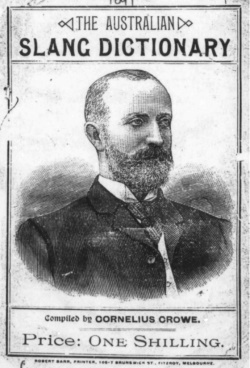
The Crowe I crow about was an Australian police officer of Irish descent, born in Tipperary in 1853 and passing from this world in the seaside Melbourne suburb of Sandringham in 1928. His claim to lexicographical fame – such as it is – is his 1895 publication An Australian Slang Dictionary. Sadly, I don’t have a copy, nor have I been able to locate a copy for sale. Barry Humphries – creator of Bazza McKenzie and one of Australia’s foremost slang promoters – has a copy, which clearly he cherishes as it has been with him since his late teens ‘despite the depredations of time, travel, and multiple divorce’, and, of course, the GDoS reference library possesses a copy of this rarity. If I do ever get a copy for myself, you know where it’s going – straight to the pool room!

Thankfully, modern technology allows one to get up close and personal with the good Cornelius’s dictionary through a PDF version, and I have scrutinised its 105 pages with a fine-toothed comb in order to come to an understanding of its contents and the author’s intentions.

Crowe produced his dictionary on the back of his publishing success of the year before, The Duties Of A Constable (1894). This booklet, set out in question and answer format, gave his first-hand account of what a constable does, and verily should do, when confronted with various species of lawbreaking. His next publishing venture, his dictionary, was advertised in Melbourne’s Age newspaper as early as March of 1895, and was on sale in all good bookstores by July of that year. An advertisement of the day ran:

AUSTRALIAN SLANG DICTIONARY. Constable Crowe, whose ‘Police Manual’ proved so successful, has just published an Australian Slang Dictionary, which should prove interesting to the curious, and instructive to the unsophisticated. It contains several thousand slang terms and specimens of the ‘lingo’ adopted by the larrikin and criminal classes of the colonies, as well as a great many everyday expressions not to be found in the standard dictionary. As the methods and habits of ‘the submerged tenth,’ it should prove of utility, and as a library curiosity it will no doubt find its way into the hands of many a purist in language, to whom a slang expression in ordinary conversation is an abhorrence. The price is a modest shilling. The Fitzroy City Press, 5 July 1895, p.3          

Crowe’s stated aim is to record lexical items (grouped under the catch-all moniker of ‘slang’) that do not appear in the standard dictionaries of the day, especially focussing on, but not exclusively so, the language of the underworld. The reason for this is to ‘prevent criminals, rogues and gamblers from conversing with impunity in the presence of the police and public’ (Crowe 1895: 1). Crowe was, after all, a career policeman and reducing crime and foiling criminal activity was his game. How useful his dictionary was in that particular enterprise is unknown; perhaps not much, but, at least it was worth a try.

One can imagine that Crowe might have expected, or at least hoped, that his dictionary would be as well received as his policing manual had been. Sadly, nothing could be further from the truth. Almost right off the bat his dictionary was subjected to uncomplimentary reviews. A. G. Stephens, the new publications reviewer for The Bulletin, Australia’s foremost weekly magazine at the time, was exceedingly harsh:

The Australian Slang Dictionary (paper, 1s. 3d.), by Cornelius Crowe, is an amazingly ignorant production. The author has mixed an olla-podrida of linguistic scraps picked up everywhere – most of which are either not Australian or not slang – and enriched it with little bits of his own. The spelling is atrocious, and the definitions are worse – e.g., ‘Pyjands, a kind of loose drawers;’ ‘Axe to grind, disseminating (!) for personal ends;’ and so on. The collection, however, is not without interest – one likes to know that ‘japanned by the Salvos’ means ‘converted by the Salvation Army;’ it has a good deal of unconscious humor – ‘bubble company’ is defined as ‘land and mining syndicates;’ and it will doubtless find the readers it deserves. The Bulletin (Sydney) 17 Aug. 1895, inside cover.

This must have hurt. A positive review in the widely-read and enormously well-respected Bulletin would have cemented Crowe’s dictionary as a classic. However, as reviews go this is pretty damning. At the same time, the review istelf is pretty terrible. The reviewer complains that Crowe’s dictionary is ‘ignorant’, but then offers practically no evidence of this (obviously pyjands is the result of a typographical or transcription error for the word ‘pyjamas’, and thus indicates a lapse in careful proofreading, not ignorance; but axe to grind can mean ‘a proposition or point of view to advocate out of self-interest’, and so while Crowe’s definition is a little clumsy, it is not wrong nor ignorant). As for the dictionary being an ‘olla-podrida’ (a hodgepodge mixture of various things), good lord! All dictionaries are a miscellaneous assortment or collection of words covering a wide range of topics, linguistic subsets, etc. Hardly a valid criticism to level at a dictionary of slang.

This leaves us with the only other criticism in the Bulletin’s damning review not yet addressed, namely that most of the lexis is not Australian (a claim, it might be added, strongly undermined by the fact that GDoS records at least 250 slang terms of Crowe’s that are also cited from The Bulletin!).

The unAustralianness of Crow’s lexis was also bemoaned by lexicographer A.A. Morris in the introduction to his own dictionary of Australianisms, who apoplectically complained that by his estimation ‘not one word in fifty in his [Crowe’s] little book has an Australian origin, or even a specially Australian use’ (1898: xi–xii). Indeed, it is this issue, the ‘Australianness’ of Crowe’s wordlist, or rather the lack thereof, that has become the enduring critique of his dictionary by all subsequent commentators, and it is the reason Crowe’s dictionary has been discarded as a piece of lexicographical trash not worthy of serious consideration – in my opinion wrongly, as we shall see.

Typical of the type of criticism that has become the sole lens through which to view Crowe’s dictionary, is the treatment of Sidney J. Baker, for long the most widely respected authority on Australian slang. Baker laments the fact that previous Australian slang dictionaries, including Crowe’s, had ‘a good deal of slang […] that was not and never has been Australian’ and that this ‘must be regarded as not only bad workmanship, but doubly unfortunate in that it encouraged unbelievers to persist in their conviction that our [Australian] slang has little originality in it.’ He goes on to complain that this caused Australian slang collectors (such as himself) ‘considerable damage in the eyes both of Australians and the English’ (1945: 26–27). What evidence Baker had of this ‘considerable damage’ remains a mystery, although, with the benefit of hindsight, I feel Baker was at best exaggerating the consequences.

Returning to the subject in 1953, Baker reductively sums up Crowe’s dictionary by stating that ‘many hundred expressions listed in’ it ‘are of English origin’ (Baker 1953: 233).

A 2005 PhD thesis, by Judith Smyth Robertson, on early Australian lexicography provides a more substantial investigation into Crowe’s dictionary, but essentially comes to the same conclusion. Robertson compares the entries in Crowe’s dictionary against some earlier British and American dictionaries and finds a large overlap, concentrated largely on Hotten’s Slang Dictionary of 1865 (or the 1874 edition) and Trumble’s Slang Dictionary of New York, London and Paris of 1881 (a work in itself largely copied from Matsell 1859). According to her calculations, Crowe’s dictionary ‘contains 2688 defined terms’, of which ‘2574 also appear in earlier dictionaries’. The conclusion Robertson draws from this is that basically 95.8% of Crowe’s dictionary, being copied from other dictionaries, is not Australian slang, and accordingly the rest of her analysis treats in detail only those terms she identifies as Australianisms.

None of this type of analysis – either from Crowe’s contemporaries or later scholars – sits well with me. Actually, such appraisals are simply misguided. Crowe was never trying to only record Australianisms, so to criticise him for not doing so is like complaining that an oil painting of roses smells like oil paint, not roses. What Crowe was recording was slang used in Australia, not slang coined in Australia. In fact, Crowe is completely upfront about this himself in the Preface to his dictionary wherein he states:

Although I have entitled the book the ‘Australian Slang Dictionary’, I would ask the reader to bear in mind that but few of the terms it contains have been invented by Australian criminals; the most of them have been brought into use by the criminal classes who have emigrated here from different parts of the world. (Crowe 1895: 1)

That the slang used in Australia in the late 19th century was replete with especially British, but also American, terms should hardly be surprising. Indeed, it would be miraculous if it were not. This should be obvious when one stops to think of the make-up of Australian society at the time. The non-Indigenous section of Australia society was essentially the result of immigration and hence was composed of migrants and the offspring of migrants. The gold-rush era (1850s–1870s), during which Australia’s population quadrupled, particularly saw an enormous influx of migrants from across the world, with an especially large number of American migrants. At the same time, the country had quite unashamedly instituted an unofficial White Australia Policy and between 1860 and 1900 there were over 400,000 ‘assisted migrants’ to Australia: principally skilled workers from Europe, especially from the UK. This is a large number of immigrants for a country that had a population of under 3.5 million in 1895. What this means is that in Crowe’s day a considerable portion of the Australian population were not even native-born speakers of Australian English. Many were speakers freshly, or only recently, arrived from Britain and they would have brought with them their own speech habits. Thus, Australian English, while going in its own direction and producing its own conventions, norms, accent, and, of course, its own slang terminology, was all the while being continually enriched with new material via immigrants arriving at a fairly high rate.

Given this societal composition, it makes sense that a dictionary of the slang in use in Australia in Crowe’s time would have a fair amount of non-Australianisms – especially Britishisms – in its make-up, as a matter of course. It is unavoidable that a mixture of local and non-local terms would be in common usage. Indeed, Australian slang was a veritable ‘olla podrida’, as it still is today. In this light, we can see that Crowe was being sensible to not restrict his dictionary solely to Australianisms. To do so would have undermined the stated aim of his book.

In an addendum, Crowe notes that ‘some of the words in this Dictionary were taken from examples of prison slang given by Mr. Michael Davitt’ who ‘had ample scope for observation during his political retirement at Newgate, Millbank, Dartmoor and Portsmouth [various British prisons], and his prison diary gives numerous specimens of the slang which he found was used by the thieving fraternity’ (1895: 105). Davitt was an Irish republican activist, writer, and lecturer who agitated for Home Rule, and served seven and a half years in British prisons where he endured solitary confinement, hard labour, and poor rations that permanently damaged his health. He wrote a two volume book detailing his time in prison, from which many citations have been added to GDoS [https://greensdictofslang.com/search/quotation?biblid=7440]. Obviously, Davitt’s lexis was British in origin, but that does not prevent any of the slang he used also being used in Australia.

Interestingly, in addition to his use of Davitt, Crowe goes on to acknowledge the ‘assistance from many other persons and sources’ and especially expresses his ‘indebtedness to Detective D.G. O’Donnell and J. O’Sullivan, of Fitzroy’ (1895: 105), fellow detectives from his local precinct. This is significant as it shows that Crowe did not rely only on his own knowledge and research, but also had input from other first-hand participants in the law and order profession.

Previous commentators, by focusing on the small amount of Australian coinages in Crowe’s dictionary, have largely assumed that the lexis which Crowe lifted from other dictionaries (and there’s no mistaking that he simply copied many, many entries verbatim from other sources) formed no part of Australian slang or Australian English. But, is this a valid conclusion? I think not. If we take the meaning of ‘Australian slang’ to be the slang used in Australia, irrespective of its point of origin, then what Crowe provides is a snapshot of the slang that was in use in his day.

Actually, by focussing on the overlap of Crowe and his lexicographical sources (i.e. what Crowe lifted from them), no one seems to have thought to examine what Crowe didn’t take. As it turns out, quite a lot! In fact, Crowe was extremely selective. I checked Crowe’s entries against four notable dictionaries he clearly used as source material:

  1. Matsell Vocabulum 1859 (American)
  2. Hotten Slang Dictionary 1874 (British)
  3. Trumble Slang Dictionary 1881 (American)
  4. Anonymous Sydney Slang Dictionary 1882 (Australian)

The following table (based on a sample – the letters A, B, and C – of the first three dictionaries, and the whole of the Sydney Slang Dictionary) shows just how selective Crowe was.

Crowe did not take 62.5% of Matsell’s terms, 70.6% of Hotten’s, 54.5% of Trumble’s, nor 74.5% of the Sydney Slang Dictionary.

Crowe did not just copy previous dictionaries holus bolus, but rather extracted only specific items. If we take time to ask why, then surely the only answer can be that his selection of terms was based on attaining his dictionary’s stated objective. In other words, he selected those terms which he thought or believed were being used in Australia, and therefore of some use to his lexicon’s goal – providing the Australian public with a useful set of terms in use amongst the underworld.

In the case of the Sydney Slang Dictionary, his only Australian source book, Crowe only took 269 entries (25.5%) of the 1053 in the original. That he rejected 74.5% as not appropriate for his dictionary reveals that he was no uncritical copyist. So, where the Sydney Slang Dictionary has entries for dead beat ‘one who evades his debts’, dead lurk ‘entering a house during church service’, and dead sucker ‘a stealer of coats and umbrellas’, none of these were chosen by Crowe for use in his dictionary, presumably because he and his colleagues had never heard them used by the criminal class of their day.

Instead, in the same section (i.e. terms beginning with dead) Crowe has eight terms.
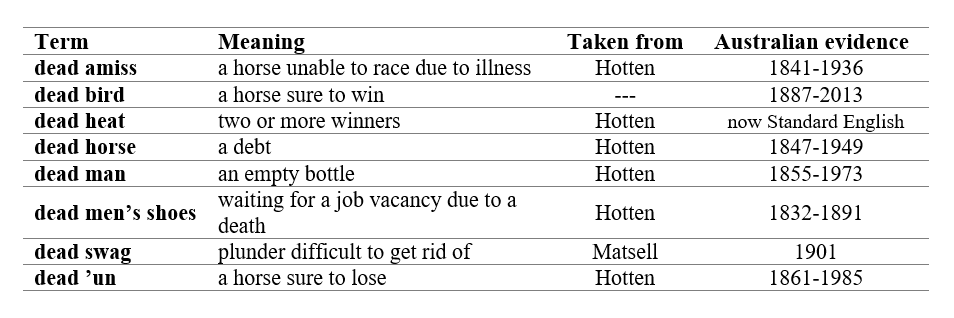
Of these, eight terms, six are recorded by Hotten (1874), and one occurs in Matsell (1859). But, when one examines the entries in GDoS, it is plain to see that, with the exception of dead swag, all the terms in Crowe’s dictionary were indeed in use in Australia prior to the publication of his dictionary in 1895. Sure, some of them were used earlier in Britain, but nevertheless the citations prove that these terms were also genuine members of Australian slang at the time, and as such may have indeed been known to Crowe and his fellow police officers who had first-hand experience dealing with underworld characters of the day.

Although I have searched high and low, I have found scant evidence for the term dead swag: the sole exception being an anonymous column in Melbourne’s Argus newspaper of September 1901. But, as the saying goes, absence of evidence does not equate to evidence of absence. Crowe appears to have lifted his dictionary entry for dead swag straight out of Matsell’s dictionary, or else Trumble’s: Crowe’s definition is exactly the same as theirs. But, presumably Crowe chose to copy this term (and not many others on the same page) for a reason, i.e., he knew it. It may have not been very common in Australia, but dictionaries are not obliged to only record common terms, in fact, they benefit by erring of the side of inclusion. Clearly the more uncommon a term is, the less likely a general reader (or listener) is to know it, and the more likely they will want to look it up in a dictionary.

Another point which must be considered when assessing Crowe’s dictionary is that today we only have an imperfect record of the language of the 1890s. In fact, what we can see today is merely a subset of what language was actually in use at the time, run through a number of sieves each of which exclude some of the whole. The sifting process goes like this: first, not all words in colloquial use in the 1890s would have necessarily made it into print; second, not everything that was in print back then is now extant (held in libraries, or even privately); third, only a fraction of total library holdings are readily available in searchable format. On this last point, although modern searchable databases – such as the enormously vast and vastly important Trove database – give the modern linguistic researcher access to so much more than was ever available before today, still not every extant 19th century book, magazine, or newspaper has been scanned in and databased – not by a long shot. As for manuscript materials, very little to none of this has been transcribed, databased, or made available.

Happily, each day more and more material comes online somewhere, and the fact that we cannot now easily find evidence for a certain word or phrase, does not mean we won’t be able to find evidence for it next year, even next week, if we look again. In particular, the massive Trove holdings have proven to be an indescribably valuable boon to Australian lexicography, and with this tool I have been able to track down much evidence that Crowe’s dictionary entries were indeed reflective of Australian slang at the time, even if not in every instance.

The following set of terms have been held up as proof of Crowe’s faulty lexicographical method (Robertson 2002).

  • bit: a tool used by burglars1
    • bower: a prison
    • copbusy: to pass stolen goods to a confederate
    • croaker: a newspaper
    • goaway: a train or tram
    • jade: a long prison sentence
    • lion: to frighten or intimidate
    • polisher: a jailbird
    • roofer: a hat
    • : to convict

For this set of terms, evidence exists for both chop up and jade, though for both the evidence is after their appearance in Crowe’s dictionary. For the others, so far no evidence has been discovered, but, with the exception of copbusy, all other words are difficult to search for as Trove’s massiveness means that any search returns an enormous number of hits. In this instance, the sheer size of Trove is a downside rather than an upside. You might think that jade is not such a common term, but Trove returns over 255,000 hits, and if advertisements are excluded there are still over 100,000 hits. Similarly, there are over 100,000 hits for croaker, which used to be the common term for an inveterate complainer, subsequently replaced in Australian English with the term whinger. Even when you search for ‘croaker’ and ‘newspaper’ together, you get over 9000 hits and to wade through each of these would take a month of Sundays. And, if you think lion as a verb, especially in the participial forms lioned and lioning, might have a more feasible number of hits to navigate, think again. Unfortunately, searches for these terms give one an incalculable number of scanning errors (known as scannos in the trade) for words ending in -tion, -tioned, -tioning, especially as this is a great place to hyphenate long words over a line break (scannos being another foible of Trove, which, to be fair, permits and encourages its users to correct such OCR errors).

In the end, Crowe’s dictionary may indeed have had a certain amount of terms that were not ever used in Australia. Maybe. But, so far, my recent investigations lead me to believe that much of what Crowe recorded did have currency in his day, and that, contra the prevailing view of Crowe, there was no significant fault with his lexicographical method. Sure, Crowe’s dictionary was hastily put together and does have a number of poor definitions, typos, and the like. He was no practised or trained lexicographer, but an amateur at the game, and in light of this, I believe that not only did he do a relatively good job but that his dictionary needs careful reconsideration and reappraisal. We won’t know how many entries in Crowe’s dictionary accurately represent Australian slang of its day without examining each and every case, and there are 2961 defined terms in the dictionary, so quite a big job. I’ve made a start, but there’s a long way to go.

The following are some of the terms that Crowe included in his dictionary and that GDoS now reveals indeed are, or at least were once, part of Australian slang:

  • absquatulate: to disappear; to decamp [US since 1833; in Australia from 1841]
  • agitate the communicator: to ring the bell [in Australia from 1859]
  • Alfred David: an affidavit [British since 1865; in Australia from 1885]
  • back slums: the low disreputable portions of a city [British since 1821; in Australia from 1834]
  • barber: a hotel barber [Australian original, first recorded in Crowe 1895]
  • barking irons: firearms [British since 1764; in Australia from 1826]
  • battler: a punter trying to make a living on the turf [an Australian original, from 1886]
  • block and tackle: a watch and chain [Australian original, since 1895]
  • bog orange: a potato [British since 1864; in Australia from 1868]
  • bone box: the mouth [British since 1788; first Australian use in Crowe]
  • chopper: a blow or punch [British since 1793; in Australia from 1835]
  • chop-up: the divvying up of stolen goods [Australian original, first recorded in Crowe]
  • cracksman: a burglar [British since 1790; in Australia from 1827]
  • federating: making love [Australian original, since 1886; the proposition for the Australian colonies to federate into a commonwealth (occurring finally in 1901) was constant news fodder of the era]
  • hotel barber: a hotel guest who robs other guests [Australian original, since 1871]
  • lushington: a drunkard [first recorded in Vaux 1812 and persisting in Australia up to the 1930s]
  • out for an airing: of a horse, running in a race but not trying to win [Australian original, since 1890]
  • piece of blue paper: a summons [Australian original, since 1879; the origin of the later bluey ‘a summons’]
  • schlog it on: to put up the price [had a brief existence in 1895 due to a much reported court case]

Australian slang has a rich history that has by and large been ignored as a consequence of Australian lexicography’s tunnel vision fixation with Australianisms. Naturally, Australia’s penal beginnings meant that underworld slang, the thieves’ patter, the flash tongue, had a healthy start in the fledgling colony, especially in the big cities of Sydney and Melbourne. A columnist writing in 1869 decries the prevalence of the flash language in Melbourne:

Perhaps in no other city is this terrible language spoken with such facility as in Melbourne. The reason is obvious. During the last twenty years has been pouring into the city a crowd of released convicts, redeemed scoundrels, adventurous vagabonds, all of whom speak this hideous tongue with facility. The Australasian (Melbourne) 17 July 1869, p. 8.

Of course, Australians were not all of the criminal class. However, I believe the desire to disavow the penal stamp has in part contributed to the disinterest in slang that was not home-grown. Crowe’s dictionary gives a valuable insight into the sort of slang that was in use in his day, and far from ignoring the lexis he records, much better would be to investigate it further so that a more complete picture of Australian English can be drawn.

Endnotes

1. Robertson (2002) defines bit as ‘jemmy, a crowbar’, but Crowe, and his source, Trumble, both define it as ‘a burglar’s instrument’. Trove has many examples of the term centre bit as a burglar’s tool, alongside the jemmy, but I could not find bit alone. I believe Robertson has mistaken the meaning in this case.  On the same page, Robertson also claims that Crowe defined japanning as ‘stealing cash-boxes’, but this is incorrect. Crowe instead has japanned ‘a thief converted by the chaplain is so spoken of’, a term going back to Matsell (1859). Where Roberton got her definition I do not know: it is not in Matsell, Hotten, Trumble, or the Sydney Slang Dictionary, nor is it in Vaux or Farmer and Henley. It is, however, a legitimate Australian slang term, albeit obsolete.

References

Baker, Sidney J. 1945. The Australian Language. Sydney: Angus and Robertson.

Baker, Sidney J. 1953. Australia Speaks. Sydney: Shakespeare Head Press.

Crowe, Cornelius. 1895. The Australian Slang Dictionary, containing the Words and Phrases of the Thieving Fraternity, together with the Unauthorised, though Popular Expressions Now in Vogue with All Classes in Australia. Fitzroy: Robert Barr.

[Hotten, John Camden]. 1874. The Slang Dictionary: Etymological, Historical, and Anecdotal. London: Chatto and Windus.

Morris, A.A. 1898. Austral English: A Dictionary of Australasian Words, Phrases and Usages. London: Macmillan and Co.

Robertson, Judith. 2002. “The perils of lexicography.” Ozwords, 9(1): 1–­3.

Robertson, Judith. 2005. Australian Lexicography 1880–1910: An Evalutation. Doctoral thesis, Australian National University, Canberra.

The Sydney Slang Dictionary: Comprising All the Slang Words and Phrases in use in Sydney and in the Shadows of Life. 1882. Sydney: H. J. Franklin.

[Trumble, Alfred]. 1881. The Slang Dictionary of New York, London and Paris. New York: National Police Gazette.

Vaux, James Hardy. 1812. “A new and comprehensive vocabulary of the flash language.” In Memoirs of James Hardy Vaux (vol. 2). 1819. London: W. Clowes.

GOVERNING GRIFTERS


‘Of all the grifters, the confidence man is the aristocrat.’ David Maurer The Big Con (1940)

‘Failing that, can the Great Exhibition/Festival UK include some of these absolute prize human exhibits? We could have a whole pavilion dedicated to Chancers, Chisellers and Chintz-grifters, and never have to leave a single street in Westminster to fill it.’ Marina Hyde Guardian 7 January 2022

It is true that google hits lie far from the essence of reliable data, but this is slang and if we require a barebones, broad-brush kind of statistic, then they serve us well. Take for instance, that currently popular term: grifter. Searching for its use in the UK over the last few years, shall we say post 16 June 2016, the search engine offers well over one million hits. Yet prior to that use outside America is almost nugatory, other than in US-based fiction of one sort or another. If, and here I hope for somewhat more reliable information, albeit infinitely less wide-ranging, you look at British use, it is, at least as recorded in GDoS, far and few between.

The term, losing its illustrative citations, looks like this:

1. (US Und.also grift) a confidence trickster; any form of non-violent criminal living primarily on his or her wits; also attrib. (recorded first use 1911)

2. (US Und.) a small-change swindler, thus any small-time gambler. (1917)

3. (US Und.) a thief. (1914)

4. a worker, a struggler. (1935)

5. (US campus) a scrounger, someone living off other people. (a.2000)

And as indicated by GDoS’s flagging system, it is clear that the term both in its earliest and subsequent uses has remained almost wholly transatlantic. A staple of pulp fiction or noir movies it has crossed the Pond only by hearsay. It simply hasn’t joined the world of British cant, i.e. criminal slang. The UK has an admirable range of equivalents, but grift has not been among them, other perhaps than among those who like to affect the linguistic stingy-brims, vines and heaters of American slang.

Its root senses emerge in the second decade of the 20th century and remain popular. Its etymological source is the verb grift, which starts life in 1905 meaning to steal, although the first use of its second sense, to work as a confidence trickster or petty thief and thus the noun grifting n., confidence trickery, swindling, has not yet been recorded before 1914 (included in a lexicon of criminal slang, it is defined unhelpfully as graft.). It is this sense that underlies the title of Jim Thompson’s 1960 novel (and Stephen Frears’ 1990 movie). The noun grift may be the verb’s source, but as things stand, its appearances are fractionally later. It’s initial use, pretty obsolete since 1960, is neutral: one’s job, though the assumption is that it tends to the criminal. Sense two, still flourishing, reflects any crime that depends not upon violence/coercion but on what David Maurer in his study of The Big Con (1940 and the basis of the 1973 hit movie The Sting) terms ‘lightness of touch and quickness of wit.’ Its variations are typically  professional confidence trickery, pickpocketing, professional gambling and, ostensibly less venal, circus and carnival work. None of these, when carried out as they should be, require physical violence, let alone gunplay. With a definite article, one has the grift: the world of (non-violent) crime and thus the light-fingered and quick-brained villain who is on the grift. Used neutrally again, the occupations can be legit, and the form echoes racket another of slang’s terms for work that walks both sides of the legal street.

Given the longevity of grift’s primary interests, one might expect its origins to lie earlier. After all, slang and criminal cant has been throwing up synonyms for confidence trickery and the like from day one. The first words for conman were verser (they verse, or ‘pour out’ their seductive schemes) and rubber (who ‘rubs up’ against the sucker), both appearing around 1550 (although the ur-victim, the gullible buzzard, is found in the late 14th century and such naïves did not exist in a vacuum, factual or lexical). Alongside came the coney-catcher, where coney was literally a rabbit, and for the criminal a victim-in-waiting. (The term doubled as a prostitute; its alternative sexualised use was as the penis, but here the coney = cunt.) But as more than a century’s examples make clear, grift and its derivative are very late-comers to British shores.

Grift’s etymology is problematic. The current theory links it to the mid-19th century slang graft, which may in turn emerge from the Standard English term meaning to insert or fix in or upon something. In this case corruption and criminality, the fine-tuning of which is considered below. Alternatively, although GDoS – following the OED – has chosen to split the two senses, it may come another form of graft, a homonym meaning hard work, usually employing physical labour. This in turn may be linked to an earlier, presumably long unused sense of graft, referring to the depth of earth that may be thrown up at once with a spade. Either way, the criminal version is first recorded in 1865, whether referring to any form of illicit, underhand – but not necessarily illegal and actionable – money-making or to one’s criminal speciality. This graft can also be used of an easy job or sinecure, the world of corruption or the profits it generates, an act of theft (rather than pure trickery), and work, here in the sense of non-productive make-work, i.e. something that takes up or wastes time, and finally influence, often political.

As to geography, these are a mixed bunch. Those senses that focus on crime and corruption are usually coined in the States, and largely stay there, although the term has gradually made its way across the ocean. The non-criminal – i.e. work and influence – are mainly linked to the UK.

Whether English dialect’s grafted, ‘deeply impressed (with dirt), begrimed’ (EDD) plays a role is unknown. It might suggest some form of connection to the earth-turning spade. But one further use of graft is definitely linked to the UK and seems to have never left: the use of graft as a verb in sexual contexts. These – meaning either to cuckold or to have vaginal or anal intercourse – are based on the back-story of horns, the symbol of cuckoldry, and the male cuckolds who are forced to sport them. The link to graft comes because although the knee-jerk assumption would be to link adultery to horn, the penis (of the lover, presumably, rather than the hapless husband). This seems an error. The  term apparently comes from an old German farming practice of grafting the spurs of a castrated cock on the root of the severed comb. These transplants would grow into horns, sometimes several inches long. The German word hahnreh or hahnrei, meaning cuckold, originally meant capon, a castrated cock. There is, unsurprisingly in so contentious a context, an alternative (and older) theory: this takes the posture of ‘missionary position’ intercourse, in which the man represented a head and the woman’s legs, spread and raised, were his horns. It is with this latter in mind that the literary publican Ned Ward wrote in his essay ‘The Dancing School’ (1700): ‘I should hate a Husband with horns, were they even of my own grafting’.

None of which has particularly changed, other than one thing: grifter, once so echt-American, has become a staple of British speech, at least as used to identify and, excoriate, on occasion even via sections of the usually partisan media, the current government and its profiteering outriders. Recent use has overtaken if not completely replaced the older sleaze, defined by the OED as ‘squalor; sordidness […]  (something of) inferior quality or low moral standards’ and a back-formation of the 17th century sleazy, used of a material and denoting its lack of texture of substance. It was initially found in 1967, but gained traction in the ’80s when its use helped destroy the last Tory hegemony, passed from Margaret Thatcher to John Major and seen as increasingly corrupt as year followed year.

Grift, as noun or verb, and especially grifter (which adds the personal aspect that sleaze did not produce) are the terms of choice now, and the levels of corruption are seen as infinitely more grotesque, injurious to the country and unrestrainedly rewarding to its beneficiaries irrespective of which section of the Tory party they represent, or what level of pro-Brexit chicanery and calculated mendacity underlines their use. The only question is to what extent these self-serving cheats possess the traditional grifter’s skills, or whether cock-up is still over-riding conspiracy.

It isn’t merely the etymologies that are confused. The senses seem interwoven. The words grift and graft, grifter and grafter slither about like a con-man’s tale. None seem set in stone. If there is a difference then perhaps it is influenced by the ‘work’ element of graft. A degree of honest toil, of honour even. No trickery there, just hard grafting. It is perhaps for this reason that grifter has finally found a home in the UK. If there is hard graft to be found, it is strictly of the most self-serving of varieties. No sweat was broken during this self-indulgent project and these thieves, tearing at at each other as Brexit’s lies deflate, lack any vestige of honour.

But even that is debatable when a clown leads the gang. As a Raymond Chandler gunsel asks Philip Marlowe in The Big Sleep: ‘Got a grift, brother — or just amusing yourself?’ Who can say, but eventually, as the departing clown car parps, sniggers and farts its way through the rubble, we shall see.

GDoS Update #21 1 October-31 December 2021

Welcome to the 21st appearance of the three-monthly upgrades of the on line version of Green’s Dictionary of Slang. A mixture of Covid and crashes have meant that the previous couple of updates have lacked their attendant, explanatory blog. My apologies. Things have slightly improved. Covid undoubtedly persists (I recently found myself using the phrase ‘mask discipline’), but thanks to the indefatigable Jesse Sheidlower, crashes have been avoided this time. herewith the usual explanatory bare bones and stats.

Fortunately working from home and extracting one’s information from digital sources is no novelty for the lone slang collector. Things have barely changed. The database has now reached some 54,150 headwords, many of which contain nested content, whether as derivatives, compounds, phrases or exclamations. In total the last three months has increased the total of available citations by 4867 (pertaining to material in 3440 headwords). The database has amassed just under 610,000 citations since the project began. I have also tried to restore some of the geographical spread that was originally researched some time ago, but had, for reasons of space, to be excluded from the print edition in 2010. That, unsurprisingly, remains an on-going project and a number of the cites gathered since 2010 have been added for that very purpose.

As ever the update offers a mix of new terms, whether from the past or as near present as research can achieve, and a number of predates of existing terms, each one gnawing yet further at that most desirable of bones, the first recorded use. Given the irreversible demise of the original, Timeglider software, I suggest that those who wish for an instant overview of what the last 90 days’ research has garnered in terms of these categories or should a pair of Excel files, which I have made available via Dropbox and which can be found here and here. They offer new slang terms and predates of existing material. The Timelines of Slang, however, remain available here.

Among the new terms are pitch the baby card v. for a cheat to encourage a victim by betting and deliberately losing; arm-hooker n. a (female) companion, whose arm is hooked through ones own, coke nail, n. the nail of a single finger that is allowed to grow disproportionately long and which can thus be used to scoop up cocaine for inhalation; good on the flute adj. loquacious; soften one’s cough v. to render someone susceptible to confessing; gruesome Gertie, the electric chair used for executions in the Louisiana State penitentiary, Angola from 1941-91; husband beater n. a long-handled parasol; jaba juntz n. a non-specific object, ‘stuff’; lick-wimble n. a heavy drinker; the Tea-pot or the Morning Slop-Basin, London’s right-wing Morning Post newspaper and the self-justificatory male phrase I can only piss with the cock I’ve got.

Predates of existing entries, working as ever on lexicography’s primary rule: ‘It’s Always older Than We Think’ run to 226. These run from out-and-outer, in the sense of a particularly gross lie, an example of which was hitherto glossarial only and listed in 1984 which has now been recorded in 1831, to various one-year alterations, such as fine as wine, first-rate, very attractive (now 1984), clucky, pregnant (1936) and smartmouth, cheeky(1979). More substantial changes can be be found with ass-whipping, a thrashing, back 142 years to 1823, stumer, in the racing sense of a horse that for corrupt betting purposes will not be allowed to win, back 77 to 1873, and an attributive use of chaw-bacon, meaning rustic, back 46 to 1832.

For this update new material, which as ever means terms that are new to the database (and which thus may date from any point during the more than half-millennium that has been researched) has added 460 entries. Among new sources are the near-entire contents of Cornelius Crowe’s Australian Slang Dictionary (Sydney 1895, 1155 terms), a follow-up to the Sydney Slang Dictionary (1882, see update #20) and between them the first attempts at antipodean slang lexicography since the lexicon published alongside James Hardy Vaux’s Memoirs of 1812/1819. Other titles include a pair of scabrous early 19th century newspapers: The Age (1835-45) and The Satirist, or Censor of the Times (1831-49). The former is perhaps best-known for its editor Charles Molloy Westmacott (1788-1868) who as ‘Bernard Blackmantle’ wrote one of many successors-cum-plagiarisms of Pierce Egan’s best-seller Life in London: The English Spy (1825). Westmacott’s paper sold well enough but its aim was blackmail and the possibilities for extortion that might spin off. He earned a highly negative portrait as the unprincipled gossip-monger ‘Sneak’ in Edward Bulwer’s England and the English (1874), and was ranked as ‘the principal blackmailing editor of his day’.

The qualifier ‘principal’ should be noted. The Age was hardly alone. Its rival and sometimes contemporary (it marginally outlived its predecessor: both fell victim to the growing moralising of ‘Victorian’ sanctimony) was Barnard Gregory’s The Satirist, with its high-sounding but wholly inapplicable subtitle ‘The Censor of the Times’. Again Gregory was a journalist who kept one hand for writing while extending the other to take bribes whereby that same writing might be suppressed. He faced the courts charged with libel and eventually served prison time. More slangy than the Age, the Satirist is a great source of what would then have been new slang. Among the terms – whether brand-new or predates – it brings to GDoS are burke, originally to rob graves, here to suppress cover up or stifle’ by cheeses! a token euphemism for Jesus, cockchafer, a woman, occasionally a man, who permits or encourages a good deal of sexual intimacy but stops short of intercourse, high and dry, one who belongs to the Anglican congregation of the Church of England (rather than an evangelical, known as a low and slow), jiggle, to have sexual intercourse and old cockalorum, sexual intercourse itself, lush room, an inn or tavern (from lush, alcohol or to drink), mud-plunger, a heavy boot for country walking, pancake, a sucker (playing on the synonymous flat), securer, a specially made dice box that facilitates cheating, toppy, drunk and lick-wimble, i.e. ‘lick-corkscrew’, a heavy drinker

As he did in the previous update, Jim Gibbons has sent in many examples of both new terms and predates of existing ones. After eviscerating the pulp fiction version of the French Foreign legion last time, he has now been through a substantial proportion of the works of Walter Dean Myers (1937-2014, an African-American author whose titles would now be grouped under the rubric of ‘Young Adult’. GDoS now offers some 460 slang terms from 34 of Myers’ books. More than 30% of these represents what are currently first recorded uses. Among them: for air, for free, bad boy, something impressive or alluring, beast, an expert, break someone’s face, to hurt someone’s feelings, calendar space, prison time, up in someone’s face, arguing, confronting, jive up, to make a mess, to ruin, perped down, looking ,ike a gangster, put (something) on, to allot responsibility, ringy-dingy, a phonecall, sticker, one who helps a heroin addict find a vein in which to inject, and do the thing, to defeat comprehensively.


Update #16 1 August-30 September 2020

Welcome to the 16th upgrade of this on line version of Green’s Dictionary of Slang. It also marks the 10th anniversary of its initial, three-volume hardbacked publication. Acute users will note that it offers only two months of research. This is to link future updates to a given year (four per: Jan.-Mar., Apr. to June, etc)) rather than, as has been the case, overflowing from one year to another (i.e. Nov.-Jan.).

As ever the update offers a mix of new terms, whether from the past or as near present as research can achieve, and a number of predates of existing terms, each one gnawing yet further at that most desirable of bones, the first recorded use. Since there are sufficient statistics below I shall skip the usual counts. Unfortunately the demise of the Timeglider software means that again and for the future the list of all these additions will no longer be available in their established blue for predate and red for neologism, but as a pair of Excel files, which can be found here and here.

Research over the last two months has focused on three major sources: a 1910s Australian newspaper, a mid-20th century list of ‘Thieves [sic] Slang’ and a very recent novel, long-listed for the current Booker Prize, which is perhaps the first such work to be written almost wholly in Multi-cultural London English (MLE).

The newspaper, The Sport, a weekly launched in Adelaide in 1911 (research has so far covered 1911-1914) has the dubious role of joining such papers as the mid-19th century New York ‘flash press’ and its London equivalents, plus a number of Australian contemporaries, notably the Sunday Times of Perth but also any paper that offered a column (often a page) headed with some version of  the titillating phrase ‘They Say’. These were plentiful and used such columns to parade a succession of what were essentially scurrilous anecdotes, usually featuring the amatory doings of well-known local figures in what skated the very thin line between gossip and libel. The excuse was that all such pars were submitted by friends of the named (named, that is, through initials which were doubtless wholly transparent in the communities from which they came).  It is not to slang’s credit that examples of its use can be found spattered over the texts, but this is slang’s world and such scurrility regularly offered terms that had yet to be recorded elsewhere.

The Thieves Slang lists – created as part of training their detectives by the Birmingham Police force of the time – were brought to my attention by a tweet from Ben Griffin, lecturer in modern British  history at Cambridge. He was kind enough to make and then send me a copy of the 1947 edition. This was then trumped, most politely, by the West Midlands Police Museum, where WMP Heritage Project Manager Corinne Brazier turned up a predecessor, seemingly the same list but with a publication date of 1935. I am very grateful to them both. The list has come up with 450-odd citations, of which many are either predates or what (nearly 150 examples) to me was new material. All are available via the update and can be searched out. Detail aside, what comes across is that this was still very much an English English slang. One can see that American words – as they were doing in the wider world –  were beginning to creep in, but the vast majority are straight out of Fabian of the Yard or Dixon of Dock Green and the world of quota quickies. All that’s missing is ‘put the bracelets on, guv, it’s a fair cop’. (No bracelets, but darbies, which goes back to 1676, is there).

Finally the novel: Who They Was by Gabriel Krauze. Reviews have been plentiful and uniformly positive, if somewhat shocked by the author’s portrait of a world that, as he points out, exists wholly parallel to that of ‘respectable’ society, except for when the former targets the latter in the hope of pillaging its wealth. Plot aside – a series of vignettes that stem from the author’s own experiences and, quite deliberately, sidesteps the slightest gesture towards morality or regret – the book offers over 400 examples of MLE, with its mix of English slang, language that has emerged from American rap and British grime, Caribbean patois and local invention. It is perhaps a niche preoccupation to class a creative work by the density of slang therein, but for lexicographical purposes, Who They Was is exemplary.

_________________________________

SPEAKING BITTERNESS*

Green’s Dictionary of Slang was published in late 2010. Its three volumes were priced at £300 (though amazon seemed able to reduce this radically and for a while such reductions saw it top the various charts in which it was eligible). It was well-reviewed and won the 2012 Dartmouth Medal of the American Library Association as ‘a reference work of outstanding quality and significance.’ In 2016, after many dead ends, the dictionary – as had always been intended – went on line. The initial plan was to make the barebones information free, but to ask for a subscription to unlock the citations or usage examples that underpinned the headwords and their various senses. It was assumed that this latter would be acceptable to academic users and their institutions, although individuals would probably not need the detailed information. The truth was that without marketing expertise, and support from a publisher, these hopes proved unfounded. As of October 2018 the dictionary was offered in its entirety to all users and for free. It has gradually expanded, on the basis of the three-monthly updates (starting in October 2016 when the digital launch included all additions since print publication), which are posted on line and incorporate the latest advances in research, whether these be additions, improvements or corrections.

Although these figures are by the dictionary’s evolving nature temporary, at this moment, its 16th update and 10th birthday, the database that provides the on line material now runs to 55,719 headwords, which cover 137,235 nested senses, derivatives, compounds, phrases and exclamations. These are underpinned by some 679,874 citations, 101,853  of which have been researched since print publication. There have also been many predatings of existing terms, but since these can have multiple examples for the same term as new discoveries push the ‘first use’ into the past, it is hard to make a count. Certainly the database as a whole far surpasses its printed predecessor, both as to quantity and, I hope, quality.

All of which should offer a moment of pleasure. It does, but it is also marred by the backstory. If it has reached this position, it is not through a loyal editor, a supportive publisher or any of the professional helpmates that a work that I am constantly informed is of such excellence, should receive. The reality is that I have been given no such help. Individual support, yes, and I am hugely grateful; institutional, nothing but what slang terms the soldier’s farewell, and that long since.

Reviewing the print edition, the cultural commentator Jonathan Meades said of slang that its role was not to offer what we are ‘enjoined to think, but what we actually do think.’ There is nothing especially revelatory to be added but I offer a few words on the dictionary’s history. If those concerned object, tough. I appreciate that it is, even in contemporary England where all previous bets seem long since off, still considered vulgar to say what one thinks. Laugh and laugh and be a villain tends to be the way. Or at least bite one’s (stiff and doubtless upper) lip. I cannot, frankly, be fucked. But then, but for the accident of geography, I am not English.

Forty years ago I chose the gig (albeit under very different circumstances) and come what may I continue to revel in it. This, I am wholly aware, is a privilege. (Though not one determined by accident of birth, skin colour, racial background, gender preference or any of the other identities currently so obsessing the pure in heart. Like slang, I lack such zealotry.) In any case, what matters is the database and the website that offers it a public life. If this is of use, it is its own justification. The backstory, while unsatisfying, is no different from many in the world of reference, where the fate of some of its most important projects  —  Jonathan Lighter’s Historical Dictionary of American Slang, the Dictionary of American Regional English (DARE)  are prime examples — has been to be abandoned by publishers for whom the bottom line demands immediate satisfaction and all else can be tossed away regardless. Lexicography is a long-term game, sometimes very long-term indeed, and we live in a short-term world; one can expect little else. (The welcoming line from my own ultimate publishers, landed with the project through the vagaries of takeovers, was ‘You know we don’t want to to publish this book.’). Even the OUP, supposed guardian of the OED, may be faltering. Anyone one who knows the story of that mighty enterprise knows too that relations between the bean-counters and the arrogant supervisory dons of late 19th century Oxford and those who actually rose each day to continue the remarkable work of making the dictionary were always fraught. But the OUP always came through, however reluctantly. It is to be hoped, worrying rumours notwithstanding, that this remains the case.

This book was commissioned at the end of the Nineties and followed on what might be seen as a trial run, a single-volume, non-cited version that in turn had been commissioned in 1993. For whatever reason, I could not have chosen a worse period to sustain a lengthy project. Within three years the company for whom the book was to be published had gone, and with it my pair of rabbis, as some New Yorkers term their professional ‘friends at court’. My then agent asked what the new owners’ plans might be. The answer: ‘we’ll publish…if we have to.’ That, it would prove, was the best I would hear. But I was effectively a decade into the game, hitting ‘delete’ was not an option. I started looking for other patrons (the cries of ‘No, don’t go!’ were deafening in their absence). A lengthy entanglement with the OUP proved futile: we almost reached the altar, but their pre-nup was just too demanding. Back to square one. In the end I was picked up by Chambers, one of the great reference publishers that emerged in late 19th century Scotland. In 2008 they published a revised single volume. I kept working on the big ’un.

Publication was finally scheduled for late 2010. Twelve months earlier, with new research paused and proofing proceeding, I was informed that Chambers too had now gone. The uber-publisher, Hachette (based in Paris, and who had already dumped the work once when Cassell, another of their properties, was killed off) promised that somehow there would be a dictionary. But for now: don’t call us, we’ll call you. Not until the new year – publication year – did I meet my new publisher. As I said, they were less than enthusiastic. But eventually there it was. I had a shirt made, and hosted a party – no-one else, it was made clear, wished to do so – and there they sat there amid the ranks of wine: three large, green volumes.

I had signed the contract in 1998 and knew, even then, that what was termed an ‘e-book’ would be absolutely vital. (Even if no-one yet knew exactly what such a thing was meant to be – the OED’s entry suggests that the primary use then referred to the electronic reader, rather than the texts it would offer). If reference publishers were becoming an endangered species, then reference itself was as vital as ever and its logical home, with limits on neither space nor the possibilities of sophisticated search, not to mention almost instant updating if one wished to do so, was due to become the only game in town. A clause was inserted into the deal: when time permitted, there would be a digital version. But as I said, the ultimate publishers, fearing even further depredations of their bottom line, refused to follow through. I didn’t like it? Then fuck off: we won’t publish you at all. It was interesting, however, that when I said, OK, let me have the electronic rights back since you don’t wish to exploit them, the gun returned to my head and a deal was made, over my opposition, for a digital facsimile – no revisions, no updates, and thus pretty much pointless – to be sold elsewhere. It was hoped, I assume, that the publisher could recoup some of their outlay. Only then was I permitted access to what was mine.

It took six years to launch a proper on-line version. I touted the project to business people, who naturally asked ‘what’s in it for me?’ and who who greeted my suggestion that there might be something in simply helping sustain a worthwhile piece of work with what social media would term ROFL and a speedy escort of this madman from the premises. I tried universities, who excused themselves: ‘wonderful idea, but we haven’t a spare penny’.  One did flirt optimistically for 12 months only to admit that in the end they hadn’t a clue of how best to do the job and must renege. Various young helpfuls emerged from Silicon Roundabout and other tech utopias, took me to high places, showed me the world, and eventually slipped away, nothing achieved other than fattening their pockets through my gullibility.

In the end the job was done. A young coder came out of nowhere (i.e. Twitter) and volunteered. The details are secondary and they are credited elsewhere here, but my gratitude is permanent. Which brings me to the point. If no institution has seen fit to support the work, then I remain hugely indebted to a number of individuals. Some are ‘in the business’, a number have written on line and in print about the work, and others are simply sympathetic and some, of course, are my loyal friends. I am also grateful to everyone who finds the dictionary useful. Were I less senescent I should produce a lengthy list, but I must beg forgiveness. Put it down to an old man’s eroding memory and my terror of overlooking anyone. The lexicography of slang has always been a solitary trade, but that needn’t make it a lonely one. It is all of you who convince me that even if at times I may believe it to be so, I am not merely an old fart sitting in a small room grubbing up yet another synonym for wanking.

Thank you.

[*‘Speak Bitterness’ (诉苦) was a form of intensive propaganda session (like all propaganda a mix of governmental diktat and the manipulation of mass ignorance and gullibility) aimed at uniting the peasants against the ‘class enemies’ (i.e. landlords) whose lands had been confiscated. The attacks were the prelude to longer, ‘struggle sessions’ which invariably incorporated stage-managed violence. My comments are nothing of the sort, but I can’t deny a certain affection for the phrase.]

What Makes a Bonzer Etymology?

Exploring the mysteries of bonzers, boshters, boskers, and bontodgers

James Lambert


[James Lambert is the Contributing Editor of Green’s Dictionary of Slang. In this special guest blog he has been looking into the etymology of one of Australia’s quintessential slang words: bonzer and with it a variety of associated terms. The conclusions he draws, based on extensive research, take our knowledge of this unique group of superlatives to a new level. Now read on. JG]


The Etymologist’s Art

Etymology is the science/art of determining the origin of words. As a discipline, it requires recourse to various linguistic subfields, especially phonology and semantics, but also an equal amount of historical research.

I say science/art quite deliberately as the wide-ranging field covers both ends of the spectrum. But, in all honesty, the watchword of all good etymologists is ‘common sense’. That common sense, however, must be predicated on cold hard evidence, without which etymological speculations are nothing more than speculations, and very often very poor speculations at that, not only because they lack any solid evidentiary basis, but because they often fly in the face of what evidence there is. In other words, etymology works best when the etymologist has a very deep understanding of the history and development of the language or languages involved (there is frequently more than one) and is also able to draw on considerable linguistic evidence.

In this blog we will examine some of the essential tools of the etymologist and see how they can be applied to sift through different and competing suggestions so that unverified and unverifiable speculations are sidelined and we are left with more realistic and likely theories.

One of the major analytic heuristics is analogy. The basic idea here is that if a certain sound or sense or spelling development is known to have occurred with a certain word or set of words some time in the past, then it is reasonable to assume that the same development could happen again. For example, take the relatively new word newb, meaning ‘a newcomer or novice’, which first appears in the 1990s. We can suggest a tentative etymology, namely, that newb is a clipping of the word newbie, which has the same meaning. Now, it doesn’t take an etymologist, nor a rocket scientist for that matter, to intuitively know that this suggested derivation is 100% correct – even to the untrained eye it is clear that newb is obviously a shortening of newbie. However, one of the reasons we can be so sure is analogy. For when we ask ourselves if there are any analogous examples, the answer is a resounding yes, there are countless analogous examples: pug ‘a boxer’, clipped from pugilist (1858); pub, clipped from public house (1800), rhino and croc clipped from rhinoceros (1858) and crocodile (1884); gym, from gymnasium (1871), and so on. One of the earliest examples being gent, a clipping of gentleman dating back to the 1600s.

In fact, the process of foreshortening words is a common formative process in the English language (and other languages besides), and as English speakers, we know this. This knowledge is part of our overall comprehension of our language and it is on the basis of our knowledge of these many analogous examples that we can be confident that newb is a shortening of newbie.

You will have noticed that I have given the examples of clipped words followed by a year in parentheses. These are, as you will of course have already discerned, the year of earliest record for each of the terms. This brings us to the next tool of the etymologist, namely, chronological precedence. Quite simply put, if a certain term is meant to be the origin of another term, then the first (called the etymon) must have existed prior to its derivative. This is just common sense. Importantly, all the examples of clippings I have given above antedate the appearance of newb, thus showing that the process of forming neologisms by clipping was already in place in the language.

Nevertheless, as common sensical as this may seem, amateur etymologists often put forward theories that completely ignore this essential point. A good example of a chronologically impossible (and therefore incorrect) etymology is for the birdwatcher’s term jizz, meaning ‘the overall structure of a bird’. The erroneous theory goes that this word was originally an acronym GISS, standing for General Impression, Shape, and Size, which was used by fighter pilots in the Second World War in reference to a method of recognising aeroplane types. The fatal problem with this theory is that the birdwatcher’s term was first used in the 1920s, considerably before WWII.

This leads us to the next implement in the etymologist’s toolbox, namely documentary evidence. As etymologies are by and large dealing with the speech habits of the past, sometimes the very ancient past, our only access to the way words were formerly used is if they happen to survive in historical texts. This is one essential that good etymologists always rely on. For example, with the jizz/GISS etymology discussed above, we know it must be wrong because there is documentary evidence that jizz was used in the 1920s (it occurs in the Manchester Guardian of the 6th of December 1921), and there is no documentary evidence that GISS was used before WWII. However, if, for instance, there were no surviving copies of the Manchester Guardian from 1921 – if say they had all destroyed during the Manchester blitz of 1940 – then the GISS derivation would have seemed eminently plausible, rather than entirely impossible.

This of course shows a weakness in etymological research – that is, it can only be as good as the documentary evidence allows. Etymologists, and lexicographers as well, are bound by the resources available to them. One can never see every use of a word, especially as most language takes place in speech and is for all practical purposes lost forever once it is spoken. Only the thinnest minuscule modicum of the daily language of billions gets written down or electronically recorded, and then only a paltry sampling of what is recorded ever passes under the gaze of the lexicographer or etymologist.

So, to conduct high quality etymology, one must have recourse to historical texts, and the more the better. Thankfully, these days more and more historical texts are being digitised and made available, and the task of the etymologist is becoming ever more easier with respect to accessing documentary evidence upon which they can conduct their careful and often painstaking detective work. And, as we shall see below, this can either make or break an etymology.

Another important string to the etymologist’s bow is historical knowledge, both linguistic and sociocultural; a knowledge of who was in contact with whom, of what languages or dialects or lingos were formerly in use and when and where they were. An absence of this can result in highly improbable folk etymologies, which, while often providing a pleasing story, are utterly ridiculous. A classic example of this I once experienced was the origin of the word pothole put forth by a tour bus driver in Bath, England. His theory, presented as absolute fact, of course, was that during the Roman occupation of England (roughly 43–84 AD) the native Celts needed clay to make pots and they took advantage of a ready supply of good clay by excavating it from Roman-built roads, leaving ‘potholes behind. This explanation was generally received with much interest and ‘oohing’ from the bus occupants, while I bit my tongue reasoning that one should never let the truth get in the way of a good story and that to deflate the tour guide in front of everyone was just bad manners. Yet, anyone with a modicum of historical knowledge will see the gross impossibility of the tale. First, during the Roman occupation of England, Celts spoke Old Brythonic and the Romans spoke Latin. The words pot and hole are both Germanic words first brought to England around 450 AD, long after the Romans had left. Second, the word pothole itself is only recorded since the beginning of the 19th century. So, as a result of ignoring historical knowledge, the tour guide’s etymology of pothole was impossible by a distance of some seventeen centuries. Third, Roman roads did not use clay, or used clay mixed with rubble as one of the lowest layers, not easy to dig up, nor very useful for potting. (Actually, the proposed etymology also fails from an absence of documentary evidence, just for good measure).

Finally, the last arrow in the etymologist’s quiver is Occam’s razor, also known as ‘the law of parsimony’. For our purposes, this simply means that when a suggested etymology requires too many steps or too many assumptions, then it is probably wrong, and suggestions with the least complexity have a greater chance of being right. This is a rule of thumb, not a hard and fast rule, but it often comes in handy. A great example of a suggested etymology that violates Occam’s razor is the famously preposterous etymology for the word hoodlum first outlined in the fourth edition of Bartlett’s Dictionary of Americanisms (1877), and restated thereafter by many authorities. Repeating a story he had heard, Bartlett posits that the word hoodlum originated by a printer’s error for the term noodlum, which is backslang for Muldoon, the name of the leader of a San Franciscan gang of street Arabs. This makes the assumption that there was a backslang version of Muldoon’s name (no evidence for this), and then the assumption that a printer made an error and typeset hoodlum instead of noodlum (no evidence for this), and then the assumption that from this single error the word entered general slang (there are, at least, a few examples of a single text contributing a new word to the slang lexicon, so this last assumption is not entirely fanciful). In any case, this piling up of assumption on assumption would make William of Occam spin in his grave, and makes the suggested etymology highly unlikely indeed. An alternate etymology suggests that hoodlum may be from German dialect words, such as hudelum ‘disorderly’, Hudellump ‘slovenly person’, and is to be preferred as it relies on less assumptions.

These principles of etymological investigation work in concert with one another, but depending on the derivation suggested often only one or two may apply. In the following, I will begin by making it clear when I am invoking one of the principles, but then will tail this explicitness off so as not to belabour the point and clutter up the text.

(more…)

UPDATE #15 1 May to 31 July 2020


Welcome to the fifteenth and latest quarterly update of the online version of Green’s Dictionary of Slang.


As ever, some statistics: research over the last three months has added 385 new slang terms; 538 entries have been predated as to their currently recorded ‘first use’ and some 4,472 new citations – including ante-dates, inter-dates and post-dates to reflect the continuing use of many terms –  have been uploaded within  2,642 terms. In total the database currently offers 55,542 headwords (within which are nested over 135,000 discrete words and phrases, underpinned by over 655,000 citations). All this material is on offer to every user.


Unfortunately, and to my own regret, the software that has up till now made it possible to offer users a timeline of new material is no longer functioning. Nor is it to be supported. Thus it has not been possible to initiate the usual link with its red and blue tags, showing antedates and new terms of slang. Instead I have created a very simple spreadsheet with Excel. Users who wish to consult this can find it at Google Drive here.


This offers both new slang terms, in alphabetical order, and ante-dates, listed by the ‘spread’ of the date as recorded on May 1 2020 and that which has replaced it after the recent quarter’s research.


Much of that research has focused on the American Underworld: The Flash Press, a collection of the American Antiquarian Society and digitized by Readex/Newsbank. These 45 titles (ranging from a single edition to runs covering multiple years) have between them provided more than two-thirds of this update’s additions and changes. I have written below on the nature of the ‘flash press’ and some of the slang terms that have been extracted from it. Other material has come from the usual wide range of sources.


The FLASH PRESS

New York & Environs 1830-1865

‘Here’s this morning’s New York Sewer! Here’s this morning’s New York Stabber! Here’s the New York Family Spy! Here’s the New York Private Listener! Here’s the New York Peeper! Here’s the New York Plunderer! Here’s the New York Keyhole Reporter!

Dickens, Martin Chuzzlewit (1844)


rowdy-jrnl

Taking his first steps through 1840s New York City, the young hero of Dickens’ Martin Chuzzlewit pays a visit to the offices of the New York Rowdy Journal. The paper was Dickens’ creation, a nod to what he saw as the trashy standards of the contemporary New York press, but there were examples to draw on, sufficient to be known collectively as the ‘flash press.’ Flash, that is, as in hedonistic, immoral, sexually sophisticated and as a result of all this, short-lived.


In the accompanying illustration by ‘Phiz’ one may see lying on a cupboard, alongside bottles marked respective ‘ink’ and ‘poison’, a volume marked ‘slang dic.’, but if there was a slang dictionary in use, then it must have been Pierce Egan’s revision of Grose or ‘Jon Bee’s’ Dictionary of the Turf, the Ring, the Chase, the Pit, &c.,  both published in 1823 and both, of course, British. America would not have a homegrown version for a further 15 years.


Its potential contents, however, were ready and waiting.


Thirty years on, writing in his Americanisms (1872) Maximilian Schele de Vere stressed that ‘the most fertile source of cant and slang, however, is, beyond doubt, the low-toned newspaper, written for the masses, which, instead, of being a monitor and an instrument of improvement in the hands of great men, has become a flatterer of the populace, and a panderer to their lowest vices.’ Nor were need the press-spread neologisms only slang. Thirty years later still James Murray of the OED acknowledged the pre-eminence of the popular press in keeping lexicographers abreast of language’s cutting edge. Neither mentioned, but but both might well have done, the ‘flash press’. It ticked their every box.


bway-omnibus


The press flourished for a decade or so. Of the titles that can be consulted, thanks to the American Antiquarian Society and the digitized versions created by Readex/NewsBank and available as American Underworld: The Flash Press, few have survived, Their names include The Whip, The Flash, Ely’s Hawk & Buzzard, The Subterranean, The Flagellator, The Scorpion, The Libertine, Life in Boston and New York (from Boston, MA), The Spy (from Manchester, NH), Venus’ Miscellany (inching towards modern pornography)  and various copycats and clones. They were very much a Yankee creation and focused on a local audience. Other ‘sporting’ journals (best known being The Spirit of the Times, its most successful editor being an ex-‘flash press’ hack, George Wilkes, formerly of The Flash) might embrace a wider America, or even if based in New York, such as the National Police Gazette, draw in readers from across the country. The hardcore did not, nor did they wish to.


They were mainly, but not uniquely American. The 1840s saw equivalents in the London (Paul Pry and Sam Sly, or The Town) and Sydney, Australia (The Satirist and Sporting Chronicle) but like their New York equivalents, they vanished almost as soon as they had started picking up readers. The punters may have enjoyed their salacious prurience, those with the power to curb it and those who found themselves its targets (sometimes one and the same) did not.


They were based on gossip, typically indicated with a wealth of initials which, were ‘reform’ (i.e. a cash payment) not made soon, would be filled out with a full name. In Dickens’ case, his 1842 trip to Gotham was noted by hints at a visit to a brothel that does not, unsurprisingly, appear in his own American Notes. As the Whip of April 23 put it ‘There was a little dog, and he had a little tail, Oh, what a living Boz you is.’ (It is also fascinating to witness how quickly Dickens creations entered common usage, almost before a new serial had been finished.) The press posed as enthusiasts of reform, but it was the same enthusiasm that has underpinned the hypocritical mouthings of generations of tabloids. The supposedly wicked were shamed, all the better to publicise the details (or at least the heavy-handed suggestions) of their sins. A column like The Rake’s ‘Invisible Spy offered all the smug spitefulness of the most dedicated and moralizing censor. Blackmail was never far away.


The columns, usually headed ‘The X [the journal’s title or alternatively a town or city’s name] Wants to Know’, played on the journal’s name to threaten ‘whipping’, ‘spying’ ‘flagellation’ and the clawed descent of both ‘hawks’, ‘buzzards’ and other birds of prey. It was these columns, of course, skating on the thinnest of ice, that would see them prosecuted and shut down. Fifty years later the tradition persisted. Columns headed ‘They Say’ in such Australian papers as the Sunday Times (from Perth, Western Australia) sailed equally close to the wind, as they retailed the scabrous suggestions of what it was that ‘they’ allegedly were saying. And if anything Australia’s racist stereotyping, bad enough in mid-century America, was even worse.


It was not all gossip. There was ‘racy’ fiction too. Foremost among its contributors was George Thompson, who also edited on occasion. His many stories mixed thinly veiled pornography (with constant references to nymphomania, pedophilia, incest, gay sex, miscegenation and group sex), true-crime stories and a fascination with the bizarre. They were regularly advertised in the press: a quarter per book and five for a buck:


thompson-list


At times the flash press became positively mainstream. There would be regular descriptions of brothel dances, with every inmate’s dress as minutely delineated as a legitimate magazine might lay out those paraded by princesses at a royal wedding. Like London’s 18th century guides to the pleasures of Covent Garden, ‘houses’ were specified, along with their address, the name and reputation of ‘Madame,’ the qualifications and charms of the inmates, and the decorations, both down- and upstairs, that clients might expect to encounter. Some journals offered pictures, of girls and of their luxurious backdrop. There were lists of drinks that one ‘nymph’ or another preferred to imbibe. There were also instructions as to the best theatres to visit if you wanted to find a partner for the night: the ‘third tier’ circle of the Chatham or the Chestnutt were especially recommended. If all else failed, there were regular mentions of Mrs Restell, New York’s best-known abortionist and allegedly protected — for a cut — by the city’s Police Commissioner Matsell. The papers, like their ‘straight’ peers, had no mutual affection. It was a rare issue rare which did not feature one savaging the other — usually on the grounds of the supposedly lax morality of their editors. The Whip and The Rake were especially barbed towards each other, reflecting, perhaps, their success and the near-identical nature of their writing.


For a detailed history of the flash papers, well illustrated by a range of excerpts, the best resource is The Flash Press: Sporting Male Weeklies in 1840s New York (2008) by Patricia Cline Cohen, Timothy J. Gilfoyle, and Helen Lefkowitz Horowitz. This looks at the sociology and when  relevant the politics behind the press; at those who edited them and those who read them and those, mainly existing within the New York sexual underworld of brothels, pimps, bawds, whores and of course clients, who provided – either as informers or participants – their stories.


Patricia Cohen and her colleagues only mention the language of the press in passing, focusing on what it said rather than the actual words and phrases that comprised it. My own researches, reading through a large proportion of the titles available, have, as is slang’s way, ignored the social backdrop, and gone for the vocabulary.


Given a source that has proved so remarkable in the fecundity of material, one word leaps out, though it has no claims on slang. Serendipity or what Shakespeare’s villainous tinker Autolycus termed the snapping up of unconsidered trifles. Not in the research, which requires serious concentration, but in what it displays: the press offers up approximately 250 hitherto unrecorded terms; in addition, and indulging the ‘historical’ lexicographer’s holy grail: the ‘first recorded use’, there are around 375 predates. But had these papers not survived – and given their lurid content most readers preferred not to start a collection – and then been made available to scholars, this information would have remained unknown and unexhumed. This, of course, is true of all research: if you don’t know it’s there, how can you interrogate it. That this small but revelatory collection has survived and is now available for excavation, only underlines its value.


What it also shows is that despite a common misbelief that America’s, which still effectively meant New York’s slang generation had yet properly to come on line, it was up and running. Twenty years later George Matsell’s Vocabulum, or The Rogue’s Lexicon, the country’s first native dictionary of slang, proved the point. To what extent he read the press is unknown; as police chief he was certainly gained regular mentions (177 appearances between 1841-71).


nysw


As a  lexicographer Matsell did his own digging. To look only at the letter ‘B’ – for which Vocabulum lists some 127 headwords –one finds the following 39 terms (nearly one third) that for which, when he published, his is the first recorded use: badger (a thief who rifles the pockets of a man who is currently engaged with his accomplice, a prostitute), badger-crib (a brothel wherein one is robbed), barney (a fake fight, arranged by criminals to distract a potential victim’s attention.), beat (to rob), beaters (boots), bet one’s eyes (to watch a game but not get involved in the betting), big thing (a large amount of plunder), bingo-boy (a drunkard), bit (arrested), blarney (a picklock), take a blinder (to die), blink (to go to sleep), bludget (a female thief), boarding house (a prison), boat (to transport a convict), boat with (to become partners with), boated (sentenced to a long term in prison), body cover (an overcoat), boke / boko (the nose), booby-hatch (a police station), boshing ( a whipping), bots (boots), bracket-mug (an ugly face), break o’day drum (an all-night tavern), break a leg (to seduce), broad-pitching (‘three-card monte’), brother (of the) bolus (a doctor), brother of the surplice (a priest), brush (to ‘soften up’ a victim), buck (an unlicensed cab-driver), bugger (a pickpocket), bully (a cosh), bummer (a scavenger), bumy-juice (beer), burned out (exhausted), burner (a card-sharp), burst (a spree), burster (a burglar), butteker and butter-ken (a shop), buttered (whipped), and button (to act as a confidence trickster’s accomplice).


crim-life


But Matsell’s list could have been even larger. The lexis offered in flash press, which he seems to have bypassed, coincides barely if at all. Both Matsell and at least one paper use burst, a spree, an indulgent party. There is badger, but as a verb, referring to the act of the girl in conning the client, and badger game, which Matsell ignores. For him boarding house is defined as a prison (he has the synonym boarding school), while the press opts for a brothel, with its attendant boarders and boarding ladies; it also regularly uses board, to live as a brothel prostitute. Matsell has a couple of brothers: of the bolus (a doctor) and the surplice (a priest) but not the press’ preference, of the brush (a painter). Both offer bummer, but the press defines him as a ‘a fast young man’, while Matsell has a ‘scrounger’ (a weak form of the earlier ‘looter’).


None of which is to invalidate the policeman. If one accepts the late 19th century report of the writer William Cumming Wilde, both criminals and policemen backed up the Vocabulum’s lexis. Wilde cited the book both to ‘one of the most desperate characters that our city has produced’ and to ‘one of the best as well as oldest detectives in our country […] a man who has followed his profession for fully half a century.’ Both supported the accuracy of Matsell’s lists. And ‘subsequent interviews with some of the best officers on our police force fully confirmed this.’ Still, one wonders what else there was, noticed by neither source. Nor, however, does it go to prove slang’s oft-suggested ephemerality. These uses by the press may be the first, but they are by no means the last. Serendip again:  no one lexicographer, even with a copper’s facilities, can collect everything; nor can a down-market hack, however well wired into his subject-matter, glean a whole lexis.


Both the slang neologisms and the pre-dating of existing terms are worth mention. Of the new terms, a small selection offers land frigate (a prostitute), sashay (to have sexual intercourse), zoe (a prostitute), gravy-eyed (insult offered a woman), carry the war into Africa (to take things further), give someone a striped jacket (to give a beating), grinding mill (a brothel), gum game (a confidence trick, though it depends not on speech, as ‘gum’ might suggest, but the activity of the opossum, which, in its efforts to elude the hunter, climbs to the very top of a gum tree, thus taking itself beyond the hunter’s reach and, since it was hunted at night, beyond his eyesight), nine months fever (pregnancy), stargazer (a womaniser, a prostitute’s client), twig the heel (to seduce), blow-breeches (a braggart,; a verbose talker), horizontal academy (a brothel), codfishopolitan (a native of Boston, MA, from the city’s prime product), prop-room (a venu specializing in the ‘thimble-rig’), bell-teazer (a hat, with a curved brim and crown), r.g. crib (a down-market tavern, selling rot-gut), work on mattresses (to work as a prostitute), mumble-peg game (sexual intercourse), gin depot/fountain (a tavern). If the topics seem somewhat monocular, thus the papers that reported on them.


Then there are the phrases: too much pork for a shilling (too much of a good thing) look marrowbones and cleavers (to stare aggressively), walk up to the ringbolt (to be hanged), go in for lemons (to commit oneself wholeheartedly), too much pumpkins (something or someone seen as excessive), not see one’s own gate an inch from one’s nose (to be ‘blind’ drunk), 2:40 on the plank road (the speedy payment of a debt; ‘2:40’ being the time of a fast trotting horse and plan road a play on ‘plank down,’ i.e. money), and eleven pennies out of the shilling (used to indicate a percentage of non-white parentage and reminiscent of British India’s not sixteen annas to the rupee) plus such street-launched catcalls as how do you live and what do you do in the daytime? with its inference of addressing a prostitute and the indefinable if you don’t look out we’ll get a camel on you!


street-view


As for the predates, and restricting ourselves to the 32 examples that have pushed back slang’s records by 100 years-plus, these are in their way even more interesting. They also are, or were, more examples of the era’s expanding slang vocabulary. (None of these terms – whether ‘new’ or ‘predates’ – are set in stone: any one of them may yet be revealed as even older).


From the longest predate in descending order they are plain sewing (anal intercourse) 171 years predate (1832<-2003), grease-pot  (an insult suggesting some form of kitchen slavey) 157 years (1848<-2005), pigville (the poor end of town, the implication, as usual with pigs, being that the locals are Irish) 156 years 1848<-2004), orangutan (a highly derogatory name for an African American) 150 years (1842<-1992), speak French  (to perform fellatio, the inevitable link of ‘dirty’ French to oral sex) 144 years (1842<-1986), burst (to go out on a spree) 142 years (1842<-1984), rigging  (usually clothes, but here the genitals) 140 years (1848<-1988), grindstone  (the vagina) 138 years (1842<-1980), miff (to get angry) 144 years (1812<-1956), sheisty (underhand, unethical) 138 years (1855<-1993); get the sack (to have one’s relationship ended) 136 years (1833<-1969), hard boy (a thug) 134 years (1851<-(1985), sack (to end a relationship) 133 years (1856<-1989), dragon (an old prostitute) 125 years (1859<-1984), horn (a womanizer) 124 years , (1843 (1967), whistle (the penis) 122 years (1843<-1965), bedhouse (a brothel) 118 years (1842<-1960), snork (a young man) 118 years (1848<-1966), banger (one who hits hard) 117 years (1842<-1959), dirty leg (a promiscuous female) 117 years (1861<-1968), cut (circumcised) 116 years (1856<-1972), horizontal (used in compounds to mean sexual intercourse, here mesmerism and amusement) 115 years (1844<-1959), chant (to talk persuasively) 114 years (1842<-1956), jug (a figurative sense of SE juggle, to fool, deceive) 113 years (1855<-1968), fast (sexy, provocative) 112 years (1848<-1960), eat dried apples (to become pregnant) 111 years (1854<-1965), pork (to have sexual intercourse) 111 years (1856<-1967), crawl (a promenade along the street) 111 years (1882<-1993), peeps (people)  109 years (1833<-1942), ointment (money) 107 years (1842<-1949), on ice (to the limit) 107 years (1861<-1958), wet deck  (a woman or prostitute who performs serial sex acts with a succession of males) 106 years (1843<-1949) and shag (a person) 103 years 1843<-1946).


Perhaps the most intriguing, is that for phat, the usual etymology of which is a deliberately skewed spelling of the positive slang term fat adj. sense 1, but which is also popularly linked to a variety of suggested abbreviations or acronyms, e.g. physically attractive or pretty hips and thighs or pretty hips, ass and tits, or pretty hot and tempting, or pussy, hips, ass and thighs etc. All of these link to sense 1, used to describe an attractive woman. Gelded of any sexuality, phat sense 2 is a term of general approval. It is here that one might place another example from the flash press: as published by New York’s Flash on 14 August 1842, ‘As it is not a very “phat” job to beat oneself […] he elevated his sparkling orbs in search of a victim.’ However the use is unique, and like slang’s fat, adj. (2), the term means substantial, wealthy and in terms of the con-trick noted here, remunerative. The skewed spelling must be attributed to the author’s personal peccadillo. It would take a further 121 years for it to reappear.


GDoS Update #11 July 31 2019


Welcome to the eleventh and latest update of the online version of Green’s Dictionary of Slang.


As ever, some statistics: research (somewhat limited by external priorities) over the last three months has added 199 new slang terms, the majority from the last few years; 216 entries have been predated as to their currently recorded ‘first use’ and  new citations – including ante-dates, inter-dates and post-dates to reflect the continuing use of many terms –  have been uploaded. In all there are 2463 new citations, appearing under 1510 headwords. In total the database currently offers 55,261 headwords (within which are nested over 135,000 discrete words and phrases, underpinned by just over 650,000 citations). All this material is on offer to every user.


For an overview, with the fruits of the last quarter’s research in chronological order, all users of the dictionary can go here.This uses the same software as the Timelines of Slang. New terms are marked in red, ante-dates in blue. As pionered in recent updates, the format has been improved: entries now link to the specific part of an entry, its sense and where pertinent its homonym number. Unfortunately the software does not permit click-through access (this is in development) , but users will be able to see at once which part of an entry has improved.


While a good proportion of the new material comes from recent publications, typically The Border (2019) the final volume of Don Winslow’s epic treatment of the Central and North American drug trade, the dictionary has also benefited hugely from the generosity of Phil Virta, publisher in charge of Gale’s Archives of Sexuality & Gender. These archives, which comprise material from the British Library’s Private Case, the New York Public Library and the Kinsey Report offer many primary sources, from 1690 to 1940, both fiction and non-fiction, that lie behind the history of sexuality. The material is available through many libraries and institutions but not, or not easily, for the independent researcher. My tweet to this end was picked up at Gale and three month free access was given me. I am hugely grateful.


The resource is wide-ranging, but not everything offers useful pickings. One must pick and choose and trust to one’s judgement to spot the plums. Of the titles I have opened, around 70 have been worth further research. The first being Pleasant quippes for upstart newfangled gentlewomen by S. Gosson (1596) and the last the collection of Limericks (1959) published by ‘Count Palamiro Vicarion’ (i.e. the British poet Christopher Logue) in his days hacking for Maurice Girodias’ Olympia Press. The bulk of the material focuses on the 18th and 19th centuries. Among the most productive titles have been two 1732 ‘‘novelisations’ of Hogarth’s similarly named series of engravings, The Harlot’s Progress (31 examples) and The Progress of a Rake (27) and The Honest Fellow, or Reveller’s Bemorandum Book (1790) by ‘Bumper Allnight, Esquire’ (106).


London being the contemporary ‘sin city’ the guidebook format was always popular: ostensibly promoting security for the visiting unwary, it offered a little soft porn in its rambling into bordellos and boudoirs, and some tips as to criminal ‘cant’. Whether such titles kept out-of-towners’ purses not to mention bodies untainted, is unknown. Titles include The Tricks of the Town Laid Open; or, A companion for country gentlemen (1755) (23), Low-life; or, One half of the world, knows not how the other half live (1764) (11), The Midnight Spy: or, A view of the transactions of London and Westminster from the hours of ten in the evening, till five in the morning (1766) (10) and Midnight Scenes and Social Photographs (1858) by ‘Shadow’ (16). Collections of ‘drolleries’  —  ballads, poems, anecdotes and the like  —  had a ready market. The Dictionary has already drawn on a number; this research has added material from The Bacchanalian Magazine (1793) (79), Hilaria. The Festive Board (1798) (64) and Cythera’s Hymnal; or, flakes from the foreskin: A collection of songs, poems, nursery rhymes, quiddities, etc., etc. never before published (1870) (79). The Honest Fellow is another of the genre.


The sexual memoir also has a role to play. Purportedly confessional and revelatory, more likely one more variety of titillatory make-believe, productive titles include ‘Experiences of a Cunt Philosopher’ (1884) in Randiana (24), ‘Lais Lovecock, containing the adventures of Miss Lais Lovecock, written by herself, etc.’ included in The  Bagnio Miscellany (1892) (24), ‘Suzan Aked’ The Simple Tale of Suzan Aked (1898 and a title best spoken aloud) (16) and The Memoirs of Madge Buford, a modern Fanny Hill (1902) by D. St John (72).


Then of course there is unalloyed porn. Crissie. A music-hall sketch of to-day (1899) (38) may, as an advertisement claimed, have been ‘evidently drawn from the life’: its titular heroine was allegedly the wife of a printer employed by the pornographer Leonard Smithers, but the back-story was irrelevant. What mattered was that ‘the whole work is very obscene.’ Two popular contemporaries were the pseudonymous ‘Ramrod’ (slang for penis) who in 1900 offered The Nocturnal Meeting (79) and Family Connections (19) and the wholly visible G.R. (Reginald) Bacchus whose works included Nemesis Hunt (1902, presumably a piece of smutty rhyming slang), Pleasure Bound ‘Afloat’ (1908) Maudie (1908) and Pleasure Bound ‘Ashore’ – all starring the same sexually self-indulgent cast-list and good for 40 terms between them. Bacchus (1873-1945) dropped out of Oxford and worked as a freelance arts reviewer before gravitating into the world of Leonard Smithers, both pornographer and publisher of such exotics as Aubrey Beardsley. The writer also pursued a double life, mixing his smutty outpourings with what Jack Smithers, son of Leonard, recalled as as ‘the most goody-goody stories for a prominent religious weekly’.


Perhaps the most intersting find of all is not, other than in its sharing of a number of popular obscenities, a piece of pornography but The German Prisoner (1930) by the British novelist James Hanley (29). Far tougher both in its imagery and its vocabulary than better-known chronicles of World War I such as Goodbye to All That or the punningly titled  Her Privates We, Hanley’s novella was printed privately and, like another of the author’s books, Boy, duly banned. Among its slang terms are backscuttle, bugger all, fuck you! johnny rollocks, shithouse and sodding. The trenches had been tough, but its language, doubtless extreme in situ, had usually been left where it fell.


The Slang Canon

We lack, or I certainly cannot track one down, a patron saint of lexicography. Let alone, to fine-tune, some similar figure standing guard over slang. Kory Stamper, the former doyenne of Merriam Webster, the American dictionary publisher, claimed Samuel Johnson for the former but given the eponymous Noah Webster’s disdain for the Great Cham, this seems something of a stretch. In any case, this is – in OED terms – only definition 2 of the term: ‘a person who typifies or is a prime exemplar of something.’ What I’m after is definition 1.: an actual saint, glorified by the authorities who do that sort of thing, and as such ‘chosen or regarded as a protector or intercessor for a person, place, occupation, etc.’ And nothing, I fear is doing. Which is a pity, since slang, surely, could come up with a decent advocatus diaboli.


Which is also a pity because of those of us who toil in the very lowest depths of what Johnson termed ‘the lower employments’ of the life lexicographical definitely need a bit of tutelary supervision. We are not helped, of course, by our own use of the word saint: Pierce Egan, revising Francis Grose’s Classical Dictionary of the Vulgar Tongue in 1823, defines the word as ‘a hypocrite’. This is hardly courting support.


Indeed, none of slang’s uses of ‘saint’ are very flattering. St Bernard: a very large, hairy penis (St Peter is a penis too, but seemingly of average dimensions); St George: sexual intercourse in the rear-entry position or with the woman on top and giving the phrase ‘ride a St George’ wherein the superior female is, of course ‘the dragon’. Sex is also found in Sallenger’s Round, properly ‘St Leger’s round,’ which was a dance and thus, like many ‘dances’ adapted as a name for fucking;  St Luke’s bird is an ox and St Marget’s ale water. Rhyming slang gives St Martin’s (le Grand), a hand, St Vitus’s dance, pants or trousers and St Louis blues, shoes. St Louis flats are also shoes: flat and moccasin-like, with a design on the toe – often that of a card suit – and once popular among jazz musicians and gamblers. Others of slang’s canonized notabilities are St Johnstone’s tippet, a hangman’s noose, a St John’s Wood dona, an up-market prostitute or kept woman (the London suburb being their residence of choice) and St Peter’s sons, petty thieves, who take anything they can lay their hands on.

(more…)

GDoS Update #7: 31 July 2018

Welcome to the seventh and latest update to the online version of Green’s Dictionary of Slang.


As ever, some statistics: research over the last three months has added 311 new slang terms, 319 entries have been predated as to their currently recorded ‘first use’ and 2,839 new citations – including ante-dates, inter-dates and post-dates to reflect the continuing use of many terms –  have been uploaded. The database currently offers 55,003 headwords (within which are nested over 133,000 discrete words and phrases, underpinned by approximately 630,000 citations). All of this new material can be seen by subscribers; the changes that are reflected by the predates  are also shown in alterations in the approximate dating used in the absence of citations: for instance ‘late 19C’ to ‘early 19C’, ‘1980s+’ back to ‘1940s+’, and so on. But as ever, for those who want or need to access the detailed and continually evolving and expanding heart of the data, we have to recommend a subscription.


For an overview, with the fruits of the last quarter’s research in chronological order, all users of the dictionary can go here. This uses the same software as the Timelines of Slang. As usual the research has focused largely on newspaper databases, notably that held by the British Library, the US Library of Congress and, for Australia, Trove. These, by their nature, tend to look backwards in time, but there is also an on-going accretion of up-to-date slang. Thus there are also a substantial number of terms from UK drill music, state of the art as regards London slang, and, to go back to the other end of slang’s history, some 17th century pamphleteering, often credited to women authors.


New terms are marked in red, ante-dates in blue. The format has been improved: entries now link to the specific part of an entry, its sense and where pertinent its homonym number. Unfortunately the software does not permit click-through access (this is in development) , but users will be able to see which part of an entry has improved.


(more…)

April 2018 Update + Hero of Slang 8: Billy Rowe

Welcome to the sixth and latest update to the online version of Green’s Dictionary of Slang.


As ever, some statistics: research over the last three months has added 301 new slang terms, 377 entries have been predated as to their currently recorded ‘first use’ and 2,775 new citations – including ante-dates, inter-dates and post-dates to reflect the continuing use of many terms –  have been uploaded. The database currently offers 54,873 headwords (within which are nested over 133,000 discrete words and phrases, underpinned by approximately 630,000 citations). All of this new material can be seen by subscribers; the changes that are reflected by the predates  are also shown in alterations in the approximate dating used in the absence of citations: for instance ‘late 19C’ to ‘early 19C’, ‘1980s+’ back to ‘1940s+’, and so on. But as ever, for those who want or need to access the detailed and continually evolving and expanding heart of the data, we have to recommend a subscription.


For an overview, with the fruits of the last quarter’s research in chronological order, all users of the dictionary can go here. This uses the same software as the Timelines of Slang. As usual the research has focused largely on newspaper databases, notably that held by the British Library, the US Library of Congress and, for Australia, Trove. These, by their nature, tend to look backwards in time, but there is also an on-going accretion of up-to-date slang.


New terms are marked in red, ante-dates in blue. The format has been improved: entries now link to the specific part of an entry, its sense and where pertinent its homonym number. Unfortunately the software does not permit click-through access (this is in development) , but users will be able to see which part of an entry has improved.

(more…)

← older entries